Colon cancer
Normal anatomy
|
|
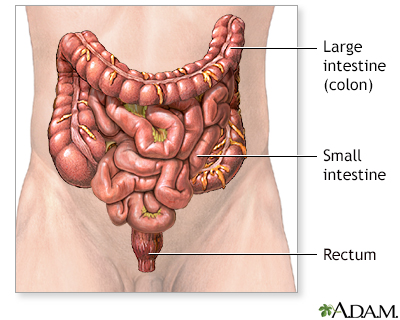
The colon, or large intestine, is a muscular tube that begins at the end of the small intestine and ends at the rectum. The colon absorbs water from liquid stool that is delivered to it from the small intestine.
|
Indication
|
|
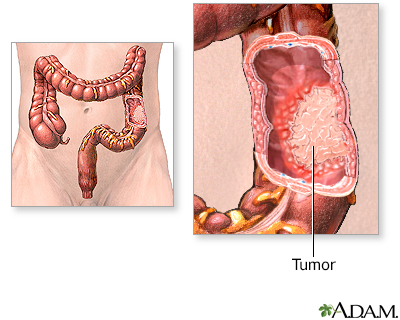
Colon cancer is the third most common cancer in the United States. Risk factors include a diet low in fiber and high in fat, certain types of colonic polyps, inflammatory bowel disease (such as Crohn disease or ulcerative colitis), and certain hereditary disorders.
|
Incision
|
|
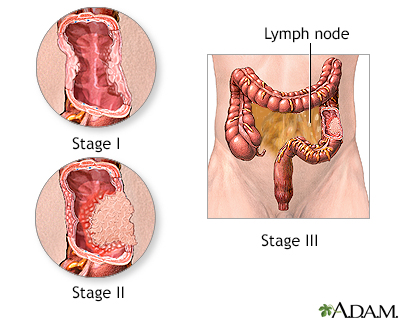
The treatment of colon cancer depends on the stage of the disease. Stage I cancer is limited to the inner lining of the colon; Stage II cancer involves the entire wall of the colon; Stage III cancer has spread to the lymph nodes; Stage IV cancer has spread to other organs (metastasized).
|
Procedure
|
|
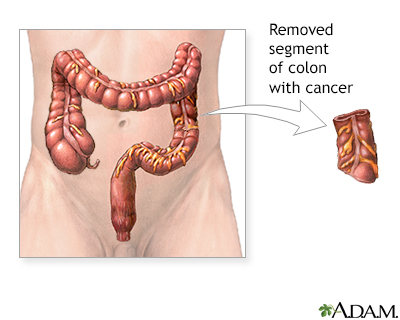
Surgery is the main treatment for colon cancer and removal of the involved colon is required. If the cancer is located near the rectum, a colostomy may be necessary. For stage I and II colon cancer, surgery is usually the only treatment. For stage III or IV colon cancer, chemotherapy is necessary after surgery. There is also some suggestion that chemotherapy may also be helpful in some selected stage II patients. Chemotherapy involves a course of drugs which are toxic to cancer cells.
|
Aftercare
|
|
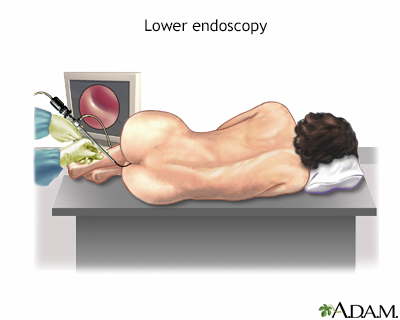
Stage I and II colon cancer have very high cure rates (60% to 90%); lower cure rates are seen with stage III and IV colon cancer. To detect colon cancer early, when it is most curable, everyone over the age of 55 should have bi-annual endoscopic examinations of the colon.
|

Review Date:4/1/2025
Reviewed By:Warren Brenner, MD, Oncologist, Lynn Cancer Institute, Boca Raton, FL. Review provided by VeriMed Healthcare Network. Also reviewed by David C. Dugdale, MD, Medical Director, Brenda Conaway, Editorial Director, and the A.D.A.M. Editorial team.
The information provided herein should not be used during any medical emergency
or for the diagnosis or treatment of any medical condition. A licensed medical professional
should be consulted for diagnosis and treatment of any and all medical conditions. Call 911
for all medical emergencies. Links to other sites are provided for information only -- they
do not constitute endorsements of those other sites. © 1997-A.D.A.M., Inc. Any duplication or distribution of the information contained herein is strictly prohibited.
The Agency for Health Care Administration (Agency) and this website do not claim the information on, or referred to by, this site is error free. This site may include links to websites of other government agencies or private groups. Our Agency and this website do not control such sites and are not responsible for their content. Reference to or links to any other group, product, service, or information does not mean our Agency or this website approves of that group, product, service, or information.
Additionally, while health information provided through this website may be a valuable resource for the public, it is not designed to offer medical advice. Talk with your doctor about medical care questions you may have.